


COMPANY NEWS | AUTOMOTIVE QUALIFICATION
Shanyo Completes Vibration and Thermal Shock Qualification of Dome Arrays for Automotive Tier-1 Programs
Automotive-grade dome arrays now carry documented vibration, thermal shock and mechanical shock data aligned with Tier-1 validation expectations.
Qingdao, China - Shanyo has completed vibration, thermal shock and mechanical shock qualification of its automotive-grade dome arrays, producing a test data package that aligns with Tier-1 switch module validation. The qualification covers the dome array configurations most common in vehicle interiors: steering wheel switches, center console panels, door module keypads and HVAC control arrays.
Automotive validation is a different world from consumer testing. The part has to survive vibration over the whole vehicle life, temperature swings from a cold soak to a sun-loaded cabin, and mechanical shock from slamming doors and rough roads - all while maintaining contact resistance and actuation force within specification. The data behind that claim has to exist before the part is approved, not after it fails in the field.
The Test Matrix
The qualification ran three profiles, each on arrays with gold-plated and nickel-plated dome options:
- Vibration: sinusoidal sweep and random vibration per automotive practice, applied in three axes, with contact resistance and force monitored before and after.
- Thermal shock: rapid cycling between -40C and +85C with dwell times, checking dome-to-carrier adhesion, force stability and contact integrity after each phase.
- Mechanical shock: half-sine pulses at defined peak accelerations, verifying that domes do not shift or reverse under impact.
Arrays passed with the key indicators intact: actuation force within +/-10 percent of the initial reading, contact resistance below the 10 ohm window for gold-plated samples, and no dome displacement beyond the registration tolerance.
Why Arrays and Adhesive Matter in Automotive
The qualification result is not automatic. In automotive environments, three things commonly fail in dome arrays:
- Adhesive creep under temperature: a PSA that softens at 85C can let domes drift under vibration. The automotive qualification uses heat-bond or high-temperature PSA systems that hold position through the cycle.
- Carrier fatigue: PET carriers flex and relax; under sustained vibration, the array can lose registration relative to the contact layer. PI carriers handle the duty cycle better where flex is continuous.
- Plating degradation: thermal cycling accelerates oxidation paths in thin plating. The qualification confirms that specified plating thicknesses keep contact resistance stable.
Shanyo documents these choices in the DFM so the design team sees why the automotive array differs from a consumer version - and what it costs.
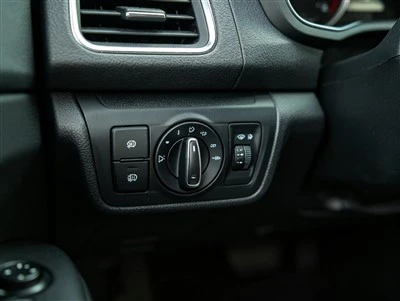
Automotive-grade domes pass vibration and thermal shock with documented data.
What the Data Package Includes
For Tier-1 programs, Shanyo delivers a qualification package with:
- Test method descriptions and the exact profiles used.
- Pre/post readings of actuation force, contact resistance and dimensional registration.
- Photographic evidence of the arrays after each test phase.
- Material certificates for the dome, carrier, adhesive and plating lots used in the qualification.
The package maps to the PPAP documentation already supplied for metal dome programs, so it drops into the Tier-1 quality workflow without translation.
Application Coverage
The qualified configurations are the current automotive program set:
- Steering wheel switch arrays - 4-key and 6-key layouts with backlight windows.
- Center console and HVAC arrays - mixed dome sizes on one carrier.
- Door module keypads - window, mirror and seat controls with heavier force domes.
- Instrument cluster shortcut keys - compact arrays on PI carriers.
For programs combining domes with silicone keypads, the module-level qualification includes the silicone key and the array as one tested assembly.
Getting the Data
Design and quality teams can request the qualification summary for review before quoting. Send the part profile through the contact page, and Shanyo will share the applicable test data and the DFM notes for the array configuration. The array vs loose dome comparison is a good starting point for teams deciding how to source the switch layer.
About Shanyo: Qingdao Shanyuan Precision Electronic Technology Co., Ltd. manufactures metal domes, dome arrays, FPC keypads, silicone keypads and stamped components for automotive, medical and consumer electronics. Visit www.yo-shan.com.


