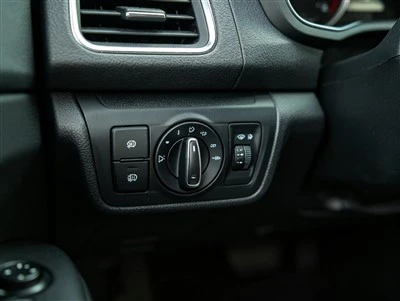
Last month a German automotive Tier-2 asked us to qualify a new metal dome stack-up for a steering-wheel switch module, and the spec called for 100 cycles of thermal shock between -40C and +105C before contact resistance could drift more than 100 mohm. Our old chamber could only run one temperature cycle every 40 minutes, which meant the qualification took five days. The customer wanted data in 48 hours. We could not do it. That was the moment we ordered the new chamber.
Today we are commissioning a two-zone thermal shock chamber rated from -65C to +150C, with a 15-second transfer time between zones and a usable basket of 500x 400 x 400 mm. It joins our existing 500-hour salt spray rig, our -40C cold chamber, and our force-curve test bench in the Qingdao environmental lab.

The environmental test corner in our Qingdao plant - force-curve bench on the left, salt spray rig in the back.
What the new chamber means for customers
A two-zone shock chamber moves the product between hot and cold zones on an elevator rather than changing the air temperature inside a single cabinet. That matters because the actual dwell time at temperature is more accurate: the product reaches setpoint in under 5 minutes instead of soaking for 30 minutes in a slow-ramp single-zone box. We can now run 100 cycles in about 18 hours instead of 5 days.
For dome sheet array programs that need IATF 16949 qualification, that turnaround difference is the difference between answering a customer on Friday and answering him next Wednesday. We can now issue a complete thermal shock report, including contact resistance measured at 0, 50, and 100 cycles, within one working day of sample receipt.
What we actually test
We are not running the chamber on empty domes. The test stack-up includes the full assembly the customer ships: the FPC, the silicone button overlay, the PET carrier, and the PSA adhesive. Dome-only data is misleading because the adhesive is the component that outgasses and contaminates the contact pad after rapid temperature swings.
Typical measurements per cycle:
- Actuation force at room temp, after hot soak, after cold soak
- Contact resistance across the center dot (four-wire measurement, 10 mA)
- Visual inspection for dome rim cracks under 10x magnification
- Adhesive transfer check on the PCB pad

SUS301 domes queued for a thermal shock run.
Who this helps most
The new chamber is most useful for three customer groups:
Automotive Tier-1 and Tier-2 suppliers. Cabin temperatures under a parked dash in summer reach 105C, and overnight in a cold-weather plant can drop to -40C. PPAP submissions now routinely require 100 to 500 thermal shock cycles on the full switch assembly.
Outdoor IoT and enclosure manufacturers. Weatherproof membrane switch panels on solar trackers, farm equipment, and roadside signage see the same swings. Thermal shock exposure often reveals weak PSA bonds that humidity testing alone misses.
Medical device OEMs. Sterilizers, autoclaves, and bedside terminals see repeated hot-cold cycling during use and cleaning. We now run these samples alongside our Class 100,000 cleanroom production line, so samples tested are built under the same conditions as production.
Specifications on the new chamber
| Parameter | Value |
|---|---|
| Temperature range | -65C to +150C |
| Transfer time | under 15 seconds |
| Dwell time | 5 min min, programmable |
| Basket size | 500 x 400 x 400 mm |
| Measurement points | Force, contact R, visual |
| Report turnaround | within 24 h of sample receipt |
What we still cannot do
We want to be straight with buyers. The new chamber does not replace our 500-hour salt spray rig, our vibration table, or our dust chamber. It fills a specific gap in our environmental lineup: rapid temperature cycling on complete assemblies. If your program needs mixed flowing gas testing or IP-rated water immersion, we subcontract to an external A2LA lab and issue their report alongside our own data.
If you are qualifying consumer electronics domes, automotive domes, or custom die-cut dome modules and need thermal shock data fast, send samples to our Qingdao lab. We return a full report within one business day. Contact Shanyo engineering to book a test slot.
- John Smith, Senior Application Engineer, Shanyo
Last month a German automotive Tier-2 asked us to qualify a new metal dome stack-up for a steering-wheel switch module, and the spec called for 100 cycles of thermal shock between -40C and +105C before contact resistance could drift more than 100 mohm. Our old chamber could only run one temperature cycle every 40 minutes, which meant the qualification took five days. The customer wanted data in 48 hours. We could not do it. That was the moment we ordered the new chamber.
Today we are commissioning a two-zone thermal shock chamber rated from -65C to +150C, with a 15-second transfer time between zones and a usable basket of 500x 400 x 400 mm. It joins our existing 500-hour salt spray rig, our -40C cold chamber, and our force-curve test bench in the Qingdao environmental lab.
The environmental test corner in our Qingdao plant - force-curve bench on the left, salt spray rig in the back.
What the new chamber means for customers
A two-zone shock chamber moves the product between hot and cold zones on an elevator rather than changing the air temperature inside a single cabinet. That matters because the actual dwell time at temperature is more accurate: the product reaches setpoint in under 5 minutes instead of soaking for 30 minutes in a slow-ramp single-zone box. We can now run 100 cycles in about 18 hours instead of 5 days.
For dome sheet array programs that need IATF 16949 qualification, that turnaround difference is the difference between answering a customer on Friday and answering him next Wednesday. We can now issue a complete thermal shock report, including contact resistance measured at 0, 50, and 100 cycles, within one working day of sample receipt.
What we actually test
We are not running the chamber on empty domes. The test stack-up includes the full assembly the customer ships: the FPC, the silicone button overlay, the PET carrier, and the PSA adhesive. Dome-only data is misleading because the adhesive is the component that outgasses and contaminates the contact pad after rapid temperature swings.
Typical measurements per cycle:
- Actuation force at room temp, after hot soak, after cold soak
- Contact resistance across the center dot (four-wire measurement, 10 mA)
- Visual inspection for dome rim cracks under 10x magnification
- Adhesive transfer check on the PCB pad
SUS301 domes queued for a thermal shock run.
Who this helps most
The new chamber is most useful for three customer groups:
Automotive Tier-1 and Tier-2 suppliers. Cabin temperatures under a parked dash in summer reach 105C, and overnight in a cold-weather plant can drop to -40C. PPAP submissions now routinely require 100 to 500 thermal shock cycles on the full switch assembly.
Outdoor IoT and enclosure manufacturers. Weatherproof membrane switch panels on solar trackers, farm equipment, and roadside signage see the same swings. Thermal shock exposure often reveals weak PSA bonds that humidity testing alone misses.
Medical device OEMs. Sterilizers, autoclaves, and bedside terminals see repeated hot-cold cycling during use and cleaning. We now run these samples alongside our Class 100,000 cleanroom production line, so samples tested are built under the same conditions as production.
Specifications on the new chamber
| Parameter | Value |
|---|---|
| Temperature range | -65C to +150C |
| Transfer time | under 15 seconds |
| Dwell time | 5 min min, programmable |
| Basket size | 500 x 400 x 400 mm |
| Measurement points | Force, contact R, visual |
| Report turnaround | within 24 h of sample receipt |
What we still cannot do
We want to be straight with buyers. The new chamber does not replace our 500-hour salt spray rig, our vibration table, or our dust chamber. It fills a specific gap in our environmental lineup: rapid temperature cycling on complete assemblies. If your program needs mixed flowing gas testing or IP-rated water immersion, we subcontract to an external A2LA lab and issue their report alongside our own data.
If you are qualifying consumer electronics domes, automotive domes, or custom die-cut dome modules and need thermal shock data fast, send samples to our Qingdao lab. We return a full report within one business day. Contact Shanyo engineering to book a test slot.
- John Smith, Senior Application Engineer, Shanyo