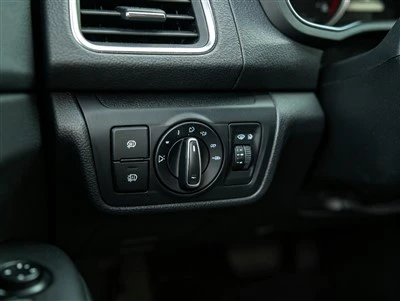
A construction equipment manufacturer called us last winter, annoyed. They had built a new excavator cab control panel using our standard dome sheet array, the same part they had used successfully on a stationary industrial controller. After six months in the field, about four percent of the panels started registering double triggers. Operators would press a single button and two functions fired at once. On a digger, that is not an annoyance - it is a safety problem.
We asked them to send back a failed panel. When we pulled it apart, the domes had shifted. The standard array is fixed to the PCB with a pressure-sensitive adhesive that works perfectly on static indoor equipment, but the excavator cab vibrates constantly: engine shake, hydraulic pump pulsing, road transport bumps. Over months, the PSA bond crept, the domes drifted out of alignment with the contacts, and adjacent domes made partial contact at the same time as the intended one. The part was not defective. It was simply the wrong fixation for a vibrating environment.
That field failure led directly to the product we are announcing today: Shanyo's vibration-resistant dome sheet array, built for off-highway, mining, agricultural and heavy machinery controls. This release explains what physically changed, how it compares with our standard PSA array on vibration tolerance, fixation method, temperature range and cost, and which buyers should spec it instead of the standard line.
What actually fails under vibration
Vibration does not usually break the stainless steel dome itself. SUS301 spring steel survives millions of cycles. The failure happens at the interfaces the user never sees: the adhesive holding the array to the PCB, the dome legs resting on the contact pads, and the silicone button over the dome moving relative to the housing. Under continuous 5 to 500 Hz shake, a soft PSA bond can shear or creep, domes can micro-shift sideways, and a leg that was centered on a contact ring ends up bridging two pads.
We tested both arrays on an electromagnetic shaker table, running 10g of acceleration across 5–500 Hz in three axes for 8 hours, at –40°C and again at 85°C. The standard PSA array showed measurable dome displacement after the thermal-shock vibration run; the vibration-resistant design held alignment within 0.05mm. That 0.05mm margin is the difference between a clean single trigger and a phantom double trigger.

Heavy machinery cab control panel assembled with the vibration-resistant dome sheet array over the PCB.
Standard array vs vibration-resistant array
The table below compares the two Shanyo production lines. Both use the same SUS301 domes and the same actuation-force range; the difference is how the array is fixed and how it handles a vibrating, temperature-swinging environment.
| Parameter | Standard PSA dome sheet array | Vibration-resistant dome sheet array |
|---|---|---|
| Fixation method | Acrylic PSA film to PCB | PSA plus perimeter bead adhesive and optional dome-leg solder retention |
| Vibration tolerance | Up to 3g, 10–500 Hz, static/indoor use | 10g, 5–500 Hz, three-axis shaker qualified |
| Dome alignment shift | Can creep under sustained shake | ≤0.05mm after thermal-shock vibration |
| Temperature range | –20°C to 70°C | –40°C to 85°C |
| Contact resistance drift | Stable in indoor use | Held under 50 milliohms across shaker cycling |
| Typical buyers | Static indoor keypads, office panels, consumer devices | Off-highway cabs, mining stations, agricultural machinery, maritime controls |
| Relative cost | Lower baseline | Approximately 15%–25% higher (extra adhesive process, fixturing, test) |
| Main limitation | Not rated for sustained vibration or wide temperature swing | Slightly more assembly steps; overkill for static indoor keypads |
What physically changed in the vibration-resistant build
Three changes do most of the work. First, we add a perimeter bead of structural adhesive around the array edges, in addition to the PSA film. The PSA locates the array during assembly; the bead locks it against shear under vibration. The bead is a silicone-rTV adhesive cured in a controlled fixture, so the array cannot lift or slide even when the PSA softens at high temperature.
Second, for the highest-shock applications we offer optional solder retention: the dome legs pass through small plated holes or rest on solder-defined pads so the dome is mechanically captured, not merely held by friction. This is the upgrade we recommend when a panel sees transport vibration plus running engine shake, as on a moving digger.
Third, we qualify the whole stack across –40°C to 85°C and run shaker testing on the first article. The PSA grade itself is upgraded to a high-temperature acrylic that does not turn soft at 85°C, which is what failed on the excavator panel when summer cab temperatures climbed and the bond crept.

Four-legged stainless steel domes used in the vibration-resistant array; the legs provide stable contact under continuous shake.
Which buyers should specify the vibration-resistant line
Construction and off-highway cabs - specify vibration-resistant. Excavators, wheel loaders, forklifts and cranes combine engine vibration, hydraulic pulsing and road transport over rough ground. The standard PSA array is the part that crept on our excavator customer; the vibration-resistant build is the fix.
Mining and quarry stations - specify vibration-resistant. Underground drill jumbos, surface crusher controls and ore-hauling cabs run in continuous shake with dust and wide temperature swings. The perimeter bead and captured legs keep the domes aligned, and the upgraded contact plating handles dusty air.
Agricultural machinery - specify vibration-resistant. Tractors, combine harvesters and sprayers vibrate through diesel engines and field travel, often in damp, muddy conditions. The vibration-rated array, paired with a sealed membrane switch panel, survives both the shake and the wash-down.
Marine and offshore controls - specify vibration-resistant. Boat helms, deck stations and offshore control cabinets see engine shake plus salt air. We pair the array with gold contacts and a corrosion-rated build for this segment.
Static indoor and consumer keypads - stay with standard PSA. Office kiosks, medical bedside terminals, TV remotes and stationary controllers see little vibration and a narrow temperature range. The vibration-resistant array is an unnecessary 15–25% cost premium there, and the standard line is the right call.
Reading a vibration specification before you order
Buyers should not ask a supplier simply "can it handle vibration?" That question has no useful answer. The specification has to be written in numbers, and the numbers come from the equipment the panel goes into. Three values matter most: acceleration in grams, frequency range in hertz, and duration per axis. A truck cab sees a different profile than a marine helm or an agricultural tractor, and a dome array qualified to one profile is not automatically qualified to another.
Acceleration describes how hard the panel is shaken. A 3g profile is a gentle indoor or light-vehicle environment; 10g is a serious off-highway or industrial profile; 20g and above is shock-heavy equipment like rock-crusher controls. Frequency range matters because adhesive creep and dome resonance happen at specific bands, usually between 100 and 500 Hz for light panels. Duration tells the supplier whether to test hours or days. When in doubt, ask the equipment maker for their existing vibration test standard - most off-highway OEMs already have one, and we can qualify the array against it directly instead of guessing.
We also ask about the mounting orientation. An array mounted horizontally behaves differently under shake than one mounted vertically, because gravity loads the dome legs in a different direction. A panel mounted behind a hinged door sees less shake than one bolted directly to the engine crossmember. These details change which fixation level we recommend, and they are the questions our application engineers ask on every rugged-program intake.
Cost trade-off, stated plainly
The vibration-resistant array costs roughly 15 to 25 percent more per unit than the standard PSA line, driven by the extra adhesive dispensing, the fixturing during cure, and the first-article shaker test. At production volumes above ten thousand arrays, that premium narrows because the fixturing cost is amortized. For a low-volume specialty machine, the premium may feel steep, but compare it against the warranty cost of a double-trigger in an excavator cab: a returned panel, a service visit and a safety complaint cost many times the per-unit difference. For rugged off-highway programs, the vibration-resistant build almost always pays back in the first year of field operation.
Common selection mistakes buyers should avoid
The first mistake is copying a fixation choice from a stationary product line. A panel that works on a desk controller will not necessarily survive on a digger, because the failure mode - creep under vibration - never appears on a benchtop test. Always ask whether the end product vibrates in service, not just whether it passes a one-time functional test in the lab.
The second mistake is assuming a heavier dome fixes a vibration problem. A heavier actuation force makes the button harder to accidentally press, but it does nothing to stop the array from sliding on the PCB. The fix is mechanical retention - perimeter bead, captured legs, fixturing - not a stiffer dome. Our engineering team reviews the whole stack-up before recommending a force or fixation change.
The third mistake is ignoring temperature. Vibration creep gets worse at high temperature because PSA softens. A panel that holds at 25°C on a shaker may drift at 85°C. We run vibration qualification at both temperature extremes, not just room temperature, because that is where field failures actually show up.
The fourth mistake is over-specifying for a quiet indoor device. The vibration-resistant build adds cost and assembly steps. If the product sits on a factory floor with no moving engine, the standard PSA array is the better economic choice. We will tell buyers when they do not need the rugged line rather than pushing the premium part.
How we qualify vibration resistance
Every vibration-resistant array undergoes first-article shaker testing: 10g acceleration across 5–500 Hz in three axes, 8 hours per axis, at –40°C and again at 85°C. After the run, we measure dome alignment under a microscope and record contact resistance on every key. Alignment must stay within 0.05mm and contact resistance under 50 milliohms across the test. The shaker report is supplied with the first article so the buyer's reliability team has documented evidence, not a verbal claim.
We also check the domes themselves after the vibration run for force drift. A dome that shifted during shake will show a changed actuation peak. We compare pre-run and post-run force on sample keys, and the lot passes only when force stays within ±10g of target across the shaker cycle.
Custom tuning, samples and lead time
Beyond the standard vibration-resistant build, we tune the fixation to the specific vibration profile: higher-shock applications get captured solder legs; moderately vibrating panels get the perimeter bead only; temperature-extreme cabins get the high-temperature PSA grade. We build prototype arrays within 48 hours for standard dome geometries, and mass production runs on a four-week lead time after sample approval. Programs for automotive and off-highway customers run under IATF 16949 process controls, with PPAP documentation where required.
Shanyo manufactures the complete keypad stack-up, not just the array: we supply the metal domes, the silicone buttons over them, the FPC flexible circuits and the sealed membrane switch housings. Sourcing the stack from one supplier removes the finger-pointing that happens when a displaced dome is blamed on the button maker while the adhesive is blamed on the array maker.
One last point: the vibration-resistant array uses the same dome footprints, actuation forces and PCB land patterns as our standard line, so a customer can switch from standard to rugged without redesigning the housing, button or FPC. That makes the upgrade a low-risk change for an existing product that is failing in the field. If you are designing a heavy machinery control panel and comparing dome sheet suppliers, request a vibration-rated sample and ask for the shaker test method. Send us your vibration profile, operating temperature range and glove or finger condition, and our team will recommend whether the standard PSA line or the vibration-resistant build fits. For custom OEM or wholesale programs, contact Shanyo with your panel drawing and field environment.
- John Smith, Senior Application Engineer, Shanyo Precision Electronics, Qingdao