A maintenance engineer at a steel rolling mill called us last spring frustrated. Their new operator control panels were shipping back after two weeks on the production line. Operators wearing thick cotton work gloves could not feel a confirmed press. They kept pushing the panel again and again, or they missed the button entirely and triggered an adjacent function. On the rare occasions they did trigger the dome, the feedback was soft enough that nobody trusted it had registered.
We asked what dome force the panel was built around. The answer: 160 grams, our standard consumer-electronics actuation force, lifted straight from an off-the-shelf catalog drawing. That was the root of the problem. A bare finger needs a light, crisp 160g dome. A thick insulated glove changes the physics completely - contact area widens, tactile transfer drops, and the operator cannot detect the snap-click that tells them the switch closed. The panel needed a high-force dome, not a standard one. We redesigned it around a 280g series, delivered prototype dome sheets in 48 hours, and the return rate dropped to near zero.
That case is why Shanyo has now added a dedicated high-force metal dome series, rated 260g to 320g, alongside our standard 130g to 180g line. This article explains what changed in the new series, how the two ranges compare on force, travel, life and cost, and which one a buyer should specify for a given product. If you are comparing options before you buy metal domes wholesale or order a custom OEM dome sheet array, the comparison table below should shorten your selection meeting.
Why one force range cannot cover every product
Actuation force is the amount of downward pressure needed to collapse the dome from its resting state to the contact point. It is measured with a force gauge mounted on a linear actuator, pressing the dome center at a controlled speed, and recorded as the peak force at the snap moment. Every dome we ship carries a force tolerance of ±10g, measured on a sample of 30 pieces per lot, with the result logged in the inspection report.
The right force depends on who presses the switch and how. A bare finger on a handheld remote control wants a light dome around 130g to 160g; too much force makes the device tiring to operate. A gloved operator on a factory panel wants a heavier dome around 260g to 320g; too little force feels mushy and unreliable. Specifying the wrong range in either direction creates a real failure mode, not a cosmetic complaint.

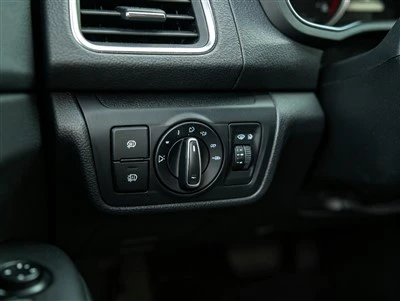
Industrial operator panel assembled around the high-force dome series, mounted on a dome sheet array over the PCB.
Shanyo dome ranges at a glance: standard vs high-force
The table below compares the two production ranges we currently offer. Figures are typical values for our four-legged stainless steel domes; round and cross domes fall in a slightly narrower force band. Talk to our engineering team for a force curve on the exact geometry you need.
| Parameter | Standard series (130g–180g) | High-force series (260g–320g) |
|---|---|---|
| Actuation force range | 130g, 150g, 160g, 180g | 260g, 280g, 300g, 320g |
| Force tolerance | ±10g per lot | ±10g per lot |
| Material | SUS301 stainless steel, 0.18mm–0.23mm | SUS301 stainless steel, 0.23mm–0.28mm |
| Dome travel (pre-travel) | 0.30mm–0.40mm | 0.35mm–0.45mm |
| Contact plating | Gold over nickel, 0.3µm gold | Gold over nickel, 0.5µm gold |
| Rated life cycle | 1 million actuations at 25°C | 800,000 actuations at 25°C |
| Typical use | Bare-finger consumer devices, handheld remotes, keypads | Thick-glove industrial panels, outdoor stations, machinery controls |
| Relative unit price | Lower baseline | Roughly 20%–30% higher (thicker material, heavier plating) |
| Main limitation | Too light for gloved or large-finger operation | Fatiguing for repeated bare-finger use; slightly shorter cycle life |
What physically changed in the high-force series
Force does not come from a stamping trick alone. To reach 260g–320g while keeping a clean snap and a stable return, we increased the dome wall thickness from 0.18–0.23mm to 0.23–0.28mm of SUS301, and we adjusted the dome curvature and leg geometry so the snap still releases sharply instead of folding over slowly. A thicker dome stores more spring energy, which is what produces the heavier actuation peak and the firm tactile click through a glove.
Because the high-force series sees harder presses and rougher handling on the factory floor, we also upgraded the contact plating to 0.5µm of gold over nickel, up from 0.3µm on the standard line. Thicker gold protects the contact from oxidation and wear in dusty, humid plant air, and keeps contact resistance under 50 milliohms across the rated life. The trade-off is material cost and a modestly shorter cycle life: 800,000 actuations versus 1 million, because a heavier dome works its stainless steel harder each cycle.

Four-legged stainless steel domes from the high-force series, gold-plated contacts for dusty industrial environments.
Reading the force curve: peak force, release force and snap ratio
When we evaluate a dome, we do not look at a single force number. The force-displacement curve records three points: the peak actuation force, the release force at which the dome snaps back, and the travel between them. The difference between peak and release force, divided by peak force, is the snap ratio. A high snap ratio means a sharp, distinct click; a low ratio means a soft, mushy feel. Our standard and high-force ranges both hold a snap ratio above 35% so the feedback stays clearly audible and tactile even under a glove.
Peak force is the pressure at the moment the dome collapses. Release force is the pressure at which the dome returns to its resting shape after the contact has been made. The gap between the two is what the operator feels as a satisfying "click." If that gap is too small, the dome feels like a flat rubber pad; if it is too large, the dome feels springy and delayed. We tune the curvature to keep the release force roughly 60% of peak force, which gives a crisp but controlled response.
Travel, or pre-travel, is how far the center moves before the contact closes. On the high-force series this runs 0.35mm to 0.45mm, slightly deeper than the standard 0.30mm to 0.40mm, because the thicker dome needs more deflection to store and release its spring energy. A designer should match this travel to the silicone button over the dome: if the button wall is too thick, it eats up the travel before the dome can collapse, and the panel feels dead. We review the combined button-plus-dome stack-up on every custom panel to make sure usable travel remains.
Material choice: why SUS301, and what other buyers ask about
Both ranges use SUS301 cold-rolled stainless steel, the standard material for snap domes because it balances spring temper, fatigue life and corrosion resistance. After stamping, the material is heat-treated to a full-hard temper so it retains its elasticity through millions of cycles. We do not switch to a softer grade to save cost, because a softer alloy relaxes over time and the actuation force drifts downward, which is exactly the force-attenuation problem buyers report after months of use.
Some customers ask about SUS304 or beryllium copper domes. SUS304 has better corrosion resistance but lower spring strength, so it cannot hold the high force or the snap ratio we target. Beryllium copper conducts electricity better and works well for low-current signal contacts, but it is more expensive and its fatigue life under repeated high-force presses is shorter. For most keypad and panel applications, SUS301 remains the right compromise; our team will explain when another alloy actually fits your requirement instead of pushing the standard line.
How we test force and life before shipment
Every production lot passes a force check on a sample of 30 pieces, measured with a calibrated force gauge at a press speed of 10 millimeters per minute. We record peak force, release force and travel for each sample, and the lot passes only when measured force stays within ±10g of the target. Contact resistance is measured at the closed position with a four-wire meter, and the lot must read below 50 milliohms. These measurements appear on the outgoing inspection sheet sent with the shipment.
Life testing runs on a pneumatic actuator at 30 cycles per minute, with a dwell of half a second at the collapsed position, at 25°C ambient. The dome is checked every 100,000 cycles for force drop and contact resistance. A dome is considered worn when force falls more than 30% below its original value or contact resistance climbs past 100 milliohms. The standard series reaches 1 million cycles on this protocol; the high-force series reaches 800,000. For customers needing a documented life report for PPAP or customer approval, we can run the full cycle test and supply the curve and data table with the lot.
Cost, volume and lead-time notes for buyers
The high-force series carries a 20% to 30% unit premium over the standard line, driven by thicker stainless stock and the heavier gold plating. At large production volumes this premium narrows, because material cost per dome drops as the stamping press runs longer. Standard geometries ship as loose domes or pre-spaced dome sheet arrays; prototype arrays are ready in 48 hours, and mass production typically runs on a four-week lead time after tooling and sample approval.
For buyers comparing factory prices across suppliers, the real comparison should include tolerance, plating thickness and documented life, not the unit price alone. A cheaper dome with a wider force spread or thinner gold plating can create field failures that cost far more in warranty than the per-piece saving. Our inspection report lets you verify what you actually received, lot after lot.
Which range should you specify, by application
Consumer electronics and handheld remotes - choose standard 130g–160g. TV remotes, smart speaker keypads, handheld scanners and small medical handhelds are operated by bare fingers, often hundreds of times per day. A light dome keeps the device comfortable, and the 1 million cycle rating covers a long product life. If you go heavier here, users report sore thumbs and slow operation.
Medical handheld and diagnostic devices - choose standard 150g–180g, with plated contacts. Clinical staff wear light examination gloves more often than heavy industrial gloves, so a mid-range standard dome still reads clearly. Medical units justify the gold contact and a cleanroom-built dome sheet array, but not the 300g force. Our medical silicone button and keypad lines are produced under ISO 13485 conditions for this segment.
Industrial machinery panels and plant stations - choose high-force 260g–300g. Control panels on lathes, conveyor stations, packaging machines and welding cells are operated through cotton, leather or insulated gloves. The heavier snap cuts through glove thickness, and the thicker gold contact survives dust and oil. This is the segment that triggered our new series.
Outdoor and public access terminals - choose high-force 280g–320g. Parking pay stations, gate keypads and outdoor HMI panels are pressed by gloved hands, work gloves and wet fingers. A firm dome resists accidental light touches from wind-blown contact or a resting sleeve, and the heavier force gives a clear confirmation in noisy outdoor conditions.
Common selection mistakes buyers should avoid
The first mistake is copying a force value from a competitor's teardown without checking the glove condition. A dome that feels perfect in a bare-finger prototype feels weak once the production panel is used with gloves. Always test the force in the actual glove the operator will wear, on the actual panel housing, before locking the specification.
The second mistake is over-specifying force to solve a feedback problem that the dome cannot fix. If a panel feels mushy, the cause may be a loose silicone button over the dome, a soft PSA pad, or a dome sitting too high in its housing - not insufficient force. Raising the actuation force without fixing those layers makes the panel harder to press without restoring clean feedback. Our engineers review the stack-up before recommending a force change.
The third mistake is ignoring cycle life after a force increase. The high-force series trades some life for a firmer feel, so a panel pressed several thousand times per day should be modeled against the 800,000-cycle rating, not the standard 1 million figure.
Custom force, samples and lead time
Beyond the listed force steps, Shanyo can tune a custom actuation force between 130g and 320g for a committed production program, adjusting material thickness and dome geometry to hit a target force curve. We supply loose domes and pre-assembled dome sheet arrays, and we integrate them into full membrane switch panels and silicone button keypads with matching FPC flexible circuits. Prototype dome sheets ship within 48 hours for standard geometries, and mass production runs to IATF 16949 process controls for automotive customers.
If you are comparing dome suppliers and want a force report before you commit, request samples from our metal dome product page. Our team will match the force range to your glove type, finger size and duty cycle, and send a lot inspection sheet showing measured force, tolerance and contact resistance. For a custom OEM or wholesale program, contact Shanyo directly with your panel drawing and operating environment.
- John Smith, Senior Application Engineer, Shanyo Precision Electronics, Qingdao