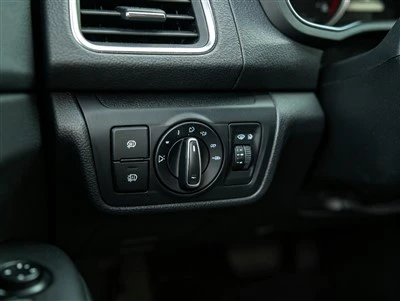
A European agricultural machinery buyer came back to us after a bad season. They had specified a standard indoor membrane switch keypad for a new tractor cab, assuming that a cab was a sealed space. It was not. The operator washed down the cab with a pressure hose at the end of each day. Dust, fertilizer spray and moisture found their way through the panel seams, and by the middle of the harvest season twelve percent of the keypads had sticky keys, intermittent triggers or dead buttons. The dealer network was replacing panels in the field, and the customer's quality team traced the failure to unsealed panel edges and uncoated contacts inside a standard keypad that had never been rated for wash-down.
We rebuilt the keypad as a sealed, outdoor-rated membrane switch stack for the next production lot. The whole panel was die-cut as one continuous sealed envelope, the edges were bonded with an acrylic adhesive rated for outdoor exposure, a Gore-style vent equalized pressure without letting water in, and the contact layer used silver-carbon with a 500-hour salt-spray rating. The field failure rate on the replaced lot dropped to under half a percent. This delivery is that second-generation keypad, shipped to the same customer for their 2027 cab platform.
This release explains what changed in the construction, how the outdoor-rated membrane keypad compares against the standard indoor keypad buyers might otherwise spec, and which agricultural, construction and industrial cab applications need the sealed version rather than the cheap indoor one.
What the agricultural cab keypad actually controls
The keypad runs the tractor's hydraulic remote controls, the PTO engagement, the lighting, the wiper and the display backlight. These are safety-relevant buttons: an operator should not have to press a sticky key twice to engage the PTO. The keypad sits to the right of the steering wheel, within gloved reach, and it sees vibration from the diesel engine, temperature swings from minus twenty in the field to forty in the cab, and repeated pressure washing at the end of a working day. A consumer remote control would not survive a season of that.
We used a 180g metal dome with four legs for the key feedback, so the operator can feel the actuation through a work glove without looking at the panel. The overlay was a hard-coated polyester that wipes clean without showing scratches, and the legends were second-surface printed, meaning they sit under the overlay and cannot wear off even after a thousand wash-downs.

The sealed membrane switch keypad for the agricultural cab; the continuous edge bond keeps wash-down water out.
Standard indoor membrane keypad vs outdoor-rated sealed keypad
Both use the same domes and the same polyester overlay. The difference is the sealing and the materials chosen for exposure. The table below compares the two on the parameters that drive field failure.
| Parameter | Standard indoor membrane keypad | Outdoor-rated sealed keypad |
|---|---|---|
| Sealing rating | IP40, dust only | IP65 to IP67, wash-down resistant |
| Edge construction | Cut edges, adhesive lamination | Continuous sealed envelope, bonded perimeter |
| Pressure equalization | None | Gore vent or equivalent, breathes without water ingress |
| Contact finish | Silver or carbon, indoor grade | Silver-carbon over plated pads, 500h salt spray |
| Temperature range | 0 to 60°C | -30 to 85°C |
| Vibration tolerance | Office and light use | Tested to 10g, 5-500Hz, three axes |
| Legend durability | Surface printed, wears with cleaning | Second-surface printed, under overlay |
| Relative cost | Lower, suitable for indoor panels | 25-40% higher, justified on exposure |
| Typical field failure | Sticky keys after 6-12 months in dust/wet use | Failure rate under 0.5% over multi-season use |
| Best-fit products | Indoor appliances, medical devices, office equipment | Cabs, construction controls, outdoor kiosks, marine panels |
What changed on the rebuilt keypad
The first change was the envelope. Instead of stacking layers and cutting the perimeter, the outdoor panel was laminated as a continuous sealed bag, with the contact layer and the domes inside and the overlay outside. There is no cut edge for water to wick into. The second change was the vent. When a keypad heats up in the sun and cools down at night, it pumps air in and out; without a vent, that pumping draws moisture in through any tiny gap. A Gore vent equalizes the pressure while blocking liquid water, which is why the failure rate stopped after we added it. The third change was the contact material: silver-carbon over nickel-plated pads that survived 500 hours of salt spray without contact resistance drift.

Four-legged SUS301 domes inside the sealed stack; the four legs keep the dome stable under gloved, high-force presses.
Which buyers should spec the sealed outdoor keypad
Cab controls in agricultural and construction machinery - choose sealed. Tractors, combines, excavators, wheel loaders and telehandlers all wash down with pressure hoses and see dust, fertilizer spray and vibration. The sealed stack is the only construction that survives a multi-season cab. A standard indoor keypad will fail in the field, and the cost of a field replacement far exceeds the 25-40% premium on the sealed version.
Outdoor kiosks and access panels - choose sealed. Parking terminals, ticket machines, building access panels and marina controls sit outside 24 hours a day. They see rain, freeze-thaw and UV exposure. The sealed envelope, the UV-stabilized overlay and the vent are the minimum spec, not the premium upgrade.
Wash-down food and medical equipment - choose sealed. Any panel that is hosed or sanitized on a daily basis needs the IP65 construction. The standard indoor keypad is not designed to resist cleaning chemicals, and the legend will wear off under repeated disinfectant.
Indoor consumer and office panels - stay with the standard keypad. A microwave control, an office printer panel or a room thermostat never sees water or dust. Specifying the sealed outdoor version there wastes money, and the thicker sealed stack changes the feel of the key without a field advantage. Buy the right grade for the exposure, not the highest spec available.
Gloved-operation panels - pair sealed with high-force domes. Where the operator wears work gloves, the dome force should be 180g to 320g rather than the 130g used for bare-finger consumer devices. We match the dome force to the glove and the overlay thickness together, because a thick sealed overlay raises the effective actuation force felt by the user.
Common selection mistakes
The first mistake is assuming a cab or enclosure is sealed. A cab is not a sealed box; it has air vents, door gaps and operator movement that pump air in and out. Pressure washing finds the seams. Specify the sealed keypad for any enclosure that is washed, not just for enclosures left fully outdoors.
The second mistake is ignoring the vent. A keypad without a vent breathes through its smallest gap, and over a year of thermal cycling that gap pumps moisture in. The vent is not an optional extra; it is the part that keeps the sealed envelope working. If a supplier quotes a sealed keypad with no vent, ask how pressure equalization is handled.
The third mistake is surface-printing legends on an outdoor overlay. Surface ink wears off under repeated wiping and UV. Second-surface printing costs a little more but puts the legend under the polyester, where water, chemicals and abrasion cannot reach it. This is a ten-cent-per-panel decision that decides whether the legend is readable after year one.
The fourth mistake is choosing a standard indoor contact finish. Silver-carbon contacts rated for indoor air tarnish and drift in resistance when exposed to humidity and sulfur compounds in fertilizer exhaust. The 500-hour salt-spray rated contact finish is the spec that prevents the intermittent-trigger failures that started this agricultural customer's complaint.
How we qualify the sealed keypad
Every production lot passes a spray test to the rated IP level, a temperature cycle test from minus thirty to eighty-five degrees, a vibration sweep to 10g across three axes, and an actuation-force check on each key. For agricultural customers shipping to European OEMs, we supply the contact resistance data, the salt-spray report and the IP test result with the lot. Prototype sealed keypads build within 48 hours for standard overlay colors and two weeks for custom legends and shapes.
Shanyo manufactures both the standard indoor membrane switch and the sealed outdoor stack, with metal domes, silicone button overlays and FPC interconnection available as integrated options. If you are specifying a cab, outdoor or wash-down panel and comparing sealed vs standard constructions, send us the exposure description, the dome force you need for gloves, and the annual volume, and our engineering team will recommend the stack and quote factory pricing for custom OEM or wholesale programs. Contact Shanyo for a sample keypad and a test report.
Cost trade-off, stated plainly
The sealed outdoor keypad costs roughly 25 to 40 percent more than the standard indoor keypad, driven by the continuous envelope lamination, the vent, the plated contact layer and the UV-stabilized overlay. That premium is easy to challenge on a quote. The comparison buyers should make is the cost of a field failure: a technician dispatched to a tractor in the harvest season, a panel replaced under warranty, and the customer trust that erodes when a safety button sticks. For agricultural and construction cabs, one avoided field service call pays for the sealed construction on dozens of panels. For an indoor appliance, none of that applies, and the standard keypad is the right economic choice.
There is also a small tooling cost for the custom overlay legends and the die-cut envelope. For a panel that runs for years in the field, that tooling is amortized quickly. For a one-off prototype, it makes sense to start with a standard overlay color and simple legends, then move to custom second-surface print once the design is locked.
What we ask for before quoting
To turn a customer's cab or outdoor control idea into a buildable keypad, we ask for four numbers: the exposure description (wash-down frequency, temperature range, UV or chemical exposure), the dome force needed for the operator's gloves, the overlay size and legend layout, and the annual volume. With those four inputs we can recommend the IP rating, the contact finish, whether a vent is required, and the dome geometry. Missing the exposure description is the most common reason a first sample comes back wrong: a panel specified as "indoor" that is actually washed down on a weekly basis.
Overlay and underlay details buyers often miss
The overlay is the surface the operator touches, and its material choice matters outdoors. Standard polyester scratches and fades under UV; we specify a hard-coated, UV-stabilized polyester for any panel left in sun. Below the overlay, a silicone button spacer can be added to raise the key area and give the operator a taller, more obvious key to find by feel, which matters on a moving tractor where the driver is watching the field rather than the panel. That silicone layer is sealed inside the envelope, so it does not compromise the IP rating.
Behind the domes, the circuit layer can be a rigid printed circuit or an FPC flexible circuit. On a curved cab surface, the FPC version follows the shape of the housing; on a flat panel, the rigid circuit is cheaper. We specify one or the other based on the housing geometry, not by defaulting to the circuit we happen to stock. Most agricultural cab programs settle on a sealed polyester overlay over FPC with a 180g four-legged dome, because the cab surface is curved and the operator wears gloves; the exact build is set after the first sample round and confirmed before mass production. The production lead time after sample approval is four weeks, and we ship the full keypad stack overlay, domes, circuit and vent together so the customer assembles one part rather than sourcing four. That single-part approach is what removed the finger-pointing between overlay supplier and dome supplier when a key failed in the field during the busy harvest season when every single hour counts.
- John Smith, Senior Application Engineer, Shanyo Precision Electronics, Qingdao