


COMPANY NEWS | AUTOMOTIVE QUALITY
Shanyo Automotive Dome Lines Now Ship with Full PPAP Documentation and 100% Force-Curve Inspection
Every reel of automotive-grade snap domes now leaves the Qingdao plant with a complete PPAP package and a tested force curve.
Qingdao, China - Shanyo has completed the rollout of a full PPAP Level 3 documentation program and 100 percent force-curve inspection across all automotive snap dome production lines. The change means that every reel of automotive-grade metal domes shipped for steering-wheel switches, door controls, seat-adjustment keypads and EV charge-port buttons now carries a complete Production Part Approval Process package and an individually verified force curve.
For buyers of automotive tactile components, this is the difference between trusting a supplier and verifying a supplier. PPAP Level 3 documentation gives your quality team the evidence they need to approve a part without running their own full validation: design records, process flow, PFMEA, control plan, capability studies and measurement system analysis are all included with the first shipment of each part number.
What 100% Force-Curve Inspection Looks Like
Force-curve testing measures the complete tactile response of a dome: the rising force, the snap point, the contact force and the return force. Historically, dome suppliers tested a sample from each lot and relied on statistical process control for the rest. Shanyo has moved to automated inline testing that checks every individual dome in automotive programs.
The inspection station uses a precision load cell and a linear actuator to press each dome to its full travel and record the force-displacement curve. Domes outside the customer's force window are automatically rejected and diverted. The system logs:
- Actuation force (F1) at the snap point, recorded for every dome.
- Contact force (F2) and return force (F3), verified within customer tolerance.
- Travel at actuation, held to +/-0.02mm for automotive programs.
- Lot statistics: mean, standard deviation, Cpk, and distribution charts.
Inline inspection adds roughly 12 milliseconds per dome and runs at line speed, so the program does not slow production. What it does change is the data available to the customer. Instead of "this lot is within spec," the shipment arrives with "these are the actual force curves of the parts on this reel."
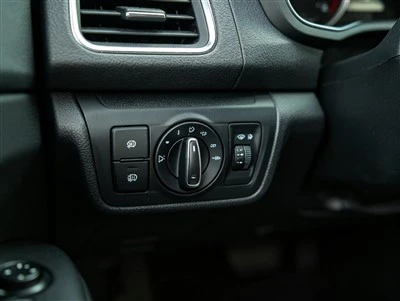
Automotive-grade snap domes released only after 100% force-curve inspection.
Why Automotive Buyers Need This
Automotive switch programs carry failure modes that consumer electronics do not. A dome that drifts 20gf higher after 50,000 cycles can trigger a customer complaint about a "stiff" button. A dome with inconsistent return force can cause a switch to feel vague at 2 degrees Celsius on a winter morning. These are not hypotheticals; they are the reasons automotive OEMs audit supplier process control.
With 100 percent inspection, the force variation that reaches the customer is no longer a statistical estimate. It is the measured range of every part shipped. For a buyer managing a steering-wheel switch program with a 250gf +/-15gf spec, that is the difference between accepting a lot on faith and accepting it on evidence.
The PPAP Package: What Is Included
Each new automotive part number ships with a PPAP Level 3 package that includes:
- Design records and dimensional report with CMM or optical measurements.
- Material certificates for the SUS301 or SUS304 coil, with mill test reports.
- Process flow diagram and process failure mode analysis (PFMEA).
- Control plan with reaction plans for out-of-spec conditions.
- Capability studies (Cpk) for force, travel and coplanarity characteristics.
- Measurement system analysis (MSA) for the inspection fixtures used.
For programs with customer-specific requirements, Shanyo also supports run-at-rate audits, on-site quality visits and annual re-approval cycles. The quality team responds to PPAP review comments within five business days.
Extended Temperature and Environmental Data
Force curves measured at 23C do not tell the whole story for automotive. Shanyo now provides optional temperature-compensated force data for automotive programs: domes are sampled at -40C, 23C and 85C, and the force shift is documented in the PPAP package. SUS301 domes typically show 4-6 percent force increase at -40C and 6-8 percent reduction at 85C, but the exact shift varies with crown geometry. Measuring it removes a variable that used to surface only during winter validation testing.
Salt-spray, humidity and vibration test data are available for plated options. For coastal and under-hood applications, Shanyo recommends gold or nickel plating depending on the environment; the choice is documented in the design record.
Beyond Automotive: What the Program Means for Other Markets
The inspection and documentation infrastructure built for automotive does not stop at automotive parts. The same inline force-curve testing is now available for medical, industrial and high-reliability consumer programs. Medical customers, who increasingly demand traceability from coil to carton, receive lot-level force data with every shipment. Industrial HMI customers with gloved-operation requirements can request the same 100 percent inspection on their part numbers.
For customers integrating domes into dome sheet arrays or FPC keypad layers, the force data is provided per array position, so downstream assembly teams can verify placement without re-testing each dome.
How to Start an Automotive Dome Program
New automotive programs typically begin with a request-for-quote that includes the switch drawing, the target force window and the environmental requirements. Shanyo responds with a design proposal, a dimensional feasibility review and a PPAP timeline. Samples with force-curve charts ship within two weeks; PPAP documentation accompanies the production part approval run.
To discuss a program, use the contact page or email the automotive sales team. Existing customers can request the new inspection reports through their account manager.
About Shanyo: Qingdao Shanyuan Precision Electronic Technology Co., Ltd. is an IATF 16949 certified manufacturer of metal domes, dome arrays, FPC keypads and stamped components. Visit www.yo-shan.com.


