Copper Bus Bar Design Basics: How Engineers Specify Materials, Ampacity, Plating and Insulation for Power Distribution
Published: September 30, 2026Reading time: 9 minCopper Bus BarPower ElectronicsIndustry Knowledge
As power density climbs in EV battery packs, solar inverters, motor drives and even household appliances, the copper bus bar has become the default answer to a simple problem: how to move hundreds of amps through millimeters of space. A stamped flat conductor carries more current per cross-section than round wire, dissipates heat better, and turns a spider-web of cables into one rigid, servicable component. This guide summarizes the material, sizing, plating and insulation decisions that determine whether a bus bar design survives its environment - or becomes the hottest joint in the system.
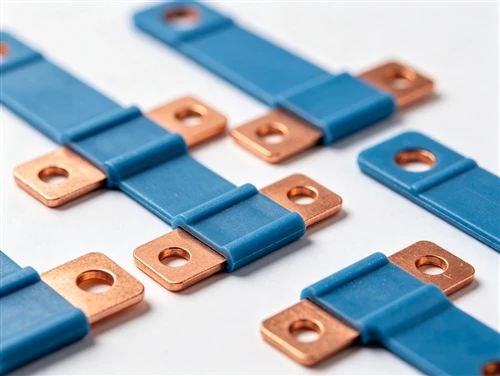
Precision-stamped, bent and insulated copper bus bars routing battery current inside an EV power distribution module.
Why Flat Conductors Beat Wire Harnesses in High-Current Paths
A rectangular cross-section offers more surface area per unit of copper than a round cable of equal ampacity, improving heat dissipation and allowing shorter, straighter runs. Stamped bus bars also hold precise terminal positions, so bolted or welded joints land exactly where the mating component expects them - a major yield advantage over hand-routed harnesses at assembly time. We compared the full electrical, thermal and assembly trade-offs in why stamped copper busbars are replacing wire harnesses; the summary: above roughly 50–100 A per conductor, flat bus bars usually win on every axis except flexibility around corners - which stamping and bending recover anyway.
Material Selection: Pure Copper vs Copper Alloys
Electrolytic tough-pitch copper (C1100 / T2) - the workhorse: ~101% IACS conductivity, excellent formability, ideal for most EV and appliance power links.
Copper alloys (e.g. phosphor bronze, brass) - trade some conductivity for spring force and wear resistance; used where the conductor must also act as a contact, as in connector tabs.
Tinned or plated variants - same base metal, surface protected; see plating below.
Precision matters as much as grade: stamped bus bars hold tight width, thickness and bend-angle tolerances so that bolted joints achieve their designed contact pressure. Shanyo's motor bus bars, for example, pair precision-stamped copper or copper-alloy conductors with insulation for motor drive environments.
Sizing for Ampacity: Cross-Section Before Everything
Current capacity scales with cross-sectional area, but real-world ampacity also depends on the allowable temperature rise, enclosure airflow and joint quality. Practical engineering practice:
| Design Factor | Rule of Thumb | Why It Matters |
|---|---|---|
| Cross-section | Size for allowable temperature rise, not just rated current | Continuous load heats joints; oversizing extends life |
| Thickness vs width | Prefer wider-over-thicker when space allows | Better surface-area-to-volume ratio improves cooling |
| Bend radius | Keep inner radius ≥ material thickness | Over-bending work-hardens copper and risks cracks |
| Plated joint areas | Keep high-current joints free of cuts and scratches | Joint resistance dominates total path heating |
| Parallel conductors | Split very high currents across parallel bars | Easier thermal management and assembly |
Surface Plating: Tin, Silver or Nickel?
Plating protects copper from oxidation and stabilizes joint resistance over years of thermal cycling:
| Plating | Strengths | Typical Use |
|---|---|---|
| Tin | Low cost, solderable, adequate for most joints | Home appliances, consumer power boards |
| Silver | Lowest contact resistance, excellent conductivity | EV battery links, inverters, high-current joints |
| Nickel | Hard, corrosion- and high-temperature resistant | Harsh environments, high-temp terminations |

Insulated bus bar with the heat-shrink sleeve peeled back: plating protects the copper; the sleeve protects everything around the copper.
Insulation Options for Dense Assemblies
Where conductors run close to each other or to chassis metal, insulation becomes part of the electrical design, not an afterthought. Common approaches include heat-shrink sleeving, laminated insulation film (as used on Shanyo's consumer electronics bus bars for compact high-density devices), and epoxy or powder coating for rigid busbar sets. Insulation choice sets the creepage and clearance budget inside the enclosure - confirm dielectric withstand requirements early with your power-electronics team.
Application-specific design notes
EV battery packs and energy storage: short, wide, silver-plated links between cells and contactors; vibration and thermal cycling drive the joint design. Shanyo has expanded automated stamping, plating and testing capacity for this market - see the EV and energy-storage bus bar expansion.
Inverters and motor drives: laminated, closely-spaced bus bars reduce loop inductance and voltage spikes at switching devices.
Household appliances: tin-plated, film-insulated bars are the economical choice - see the home appliance bus bar reference design.
Quality Evidence to Require From a Bus Bar Manufacturer
For automotive and safety-relevant power paths, treat the bus bar as a safety component: require IATF 16949-certified production, PPAP documentation where applicable, material certificates per lot, and 100% electrical verification of continuity and hi-pot isolation. Shanyo manufactures precision-stamped copper bus bars under IATF 16949 with the same inspection discipline applied to its automotive metal dome lines, alongside complementary components such as FPC flexible circuits and metal dome switches used on the same HMI and power assemblies.
Engineering tip: the weak point of any bus bar system is rarely the bar itself - it is the joint. Specify plated joint areas, controlled bolt torque, and keep stamped burrs away from contact faces. A small burr spec in the drawing saves field failures later.
From Design to Stamped Volume Production
Shanyo has stamped precision copper bus bars in Qingdao for 22+ years, serving EV battery, solar inverter, motor drive and appliance programs with free samples and factory-direct pricing. Share your conductor drawing, current profile and insulation requirements for a DFM review and quotation.